
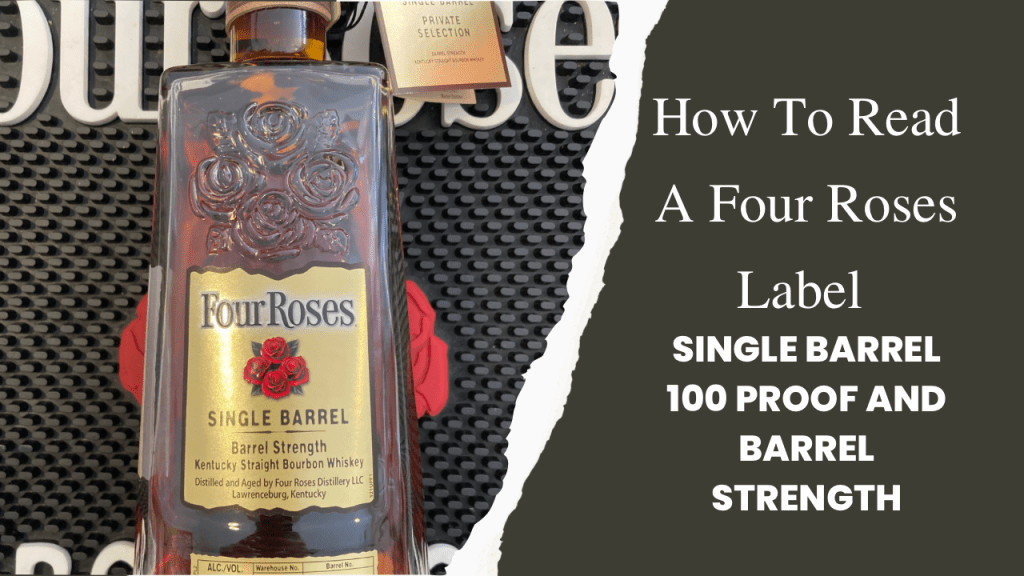
When a casual bourbon drinker first stumbles across a Four Roses Single Barrel 100 Proof or a Four Roses Single Barrel Barrel Strength, one of the first questions asked is, “How do you read a Four Roses label?” I’ll admit it can be confusing because a single barrel bottle usually contains the recipe, mashbill, yeast strain, age, possibly tasting notes, proof, warehouse location, tier and specific barrel placement.
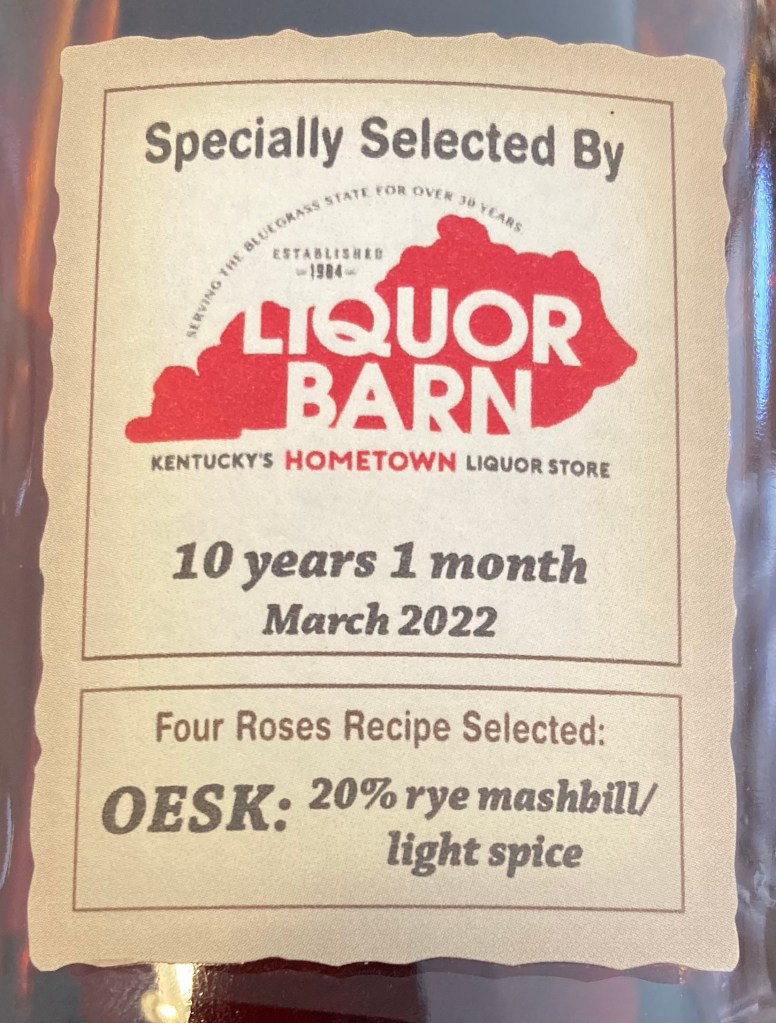
All Four Roses Barrel Strength Single Barrels should have a side label indicating which of the 10 unique recipes is in this specific bottle. The recipe is indicated by a four letter code. The first and third letters are always the same, O_S_. The “O” stand for Old Prentice Distillery, which Four Roses used to be named and the “S” stands for Straight Whiskey. The second letter (mashbill) and fourth letter (yeast) will change depending on the recipe.
Mashbill
E – 75% Corn, 20% Rye, 5% Malted Barley
B – 60% Corn, 35% Rye, 5% Malted Barley
Yeasts
F – Herbal Notes (Tobacco, Rye, Mint, Earthy).
K – Slight Spice (Baking Spices, Rye, Full Body)
O – Rich Fruit (Berries, Stone Fruit)
Q – Floral Essence (Floral, Rye)
V – Delicate Fruit (Lighter fruit notes, Creamy)
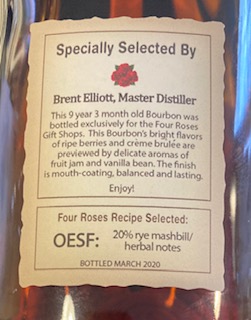
When you combine the O_S_ with the mashbill and yeast you get 10 recipe names.
OESF – Mint, Fruity, Full Body
OESK – Spicy, Full Body
OESO – Fruity (Red Berries), Medium Body
OESQ – Floral (Rose Petal & Acacia), Banana, Refreshing, Medium Body
OESV – Delicate Fruity, Fresh, Creamy
OBSF – Mint, Fruity, Spicy, Full Body
OBSK – Rich In Spiciness, Full body
OBSO – Slightly Fruity, Spicy, Medium Body
OBSQ – Floral (Rose Petal), Spicy, Medium Body
OBSV – Delicate Fruit (Pear, Apricot), Spicy, Creamy
Now let’s dissect the single barrel info provided. The first example will be from a Four Roses single barrel 100 proof offering. All of these bottles will be the OBSV recipe and are not barrel picks (older bottlings might be a store pick). Four Roses 100 Proof Single Barrel is a standard release from the distillery. Since these are all the OBSV recipe there will not be a side label. On the front of the bottle there are two labels. The larger top label and the smaller bottom label. The bottom label is the one of interest.
ALC/VOL
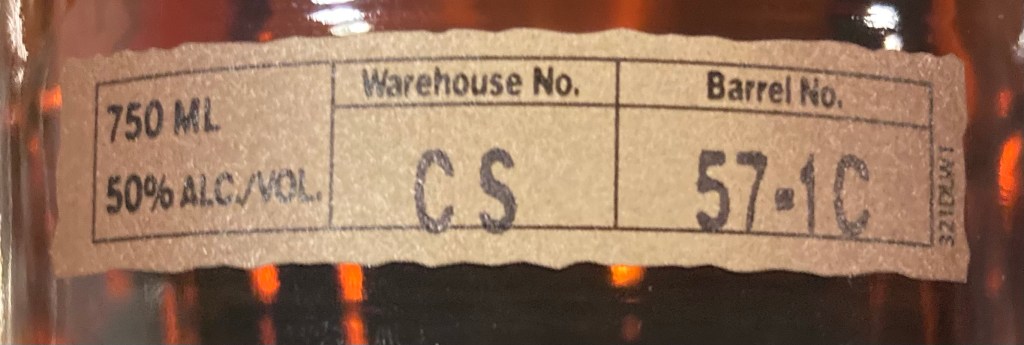
The far left box on the bottom label will list the “ALC./VOL.” as a percentage (which if doubled will give the proof). This box is standard 750mL, 50% ALC./VOL. on the 100 proof single barrel. This box will change with the barrel strength single barrels and reflect that specific barrel’s alcohol percentage.

Warehouse No.
The middle box will list the “Warehouse No” which is notated by two letters. The first letter will identify the rickhouse the barrel was aged in. The second letter tells us which side (North, South, East or West) of the rickhouse the barrel was aged. Examples provided in the images here are CS, MW, QN.
Barrel No.
The last box to examine is “Barrel No”. The first number identifies the rick number that the barrel was aged on. There are 48 ricks in each side of a Four Roses warehouse, totaling 192 ricks per warehouse. After the rick number there is a “-“ followed by a number indicating the tier, or level, of the rickhouse the barrel was kept. At Four Roses the tier number will be 1 through 6. The number 1 being the bottom tier and 6 being the highest tier. Following the tier number is a letter telling us the position of the barrel on that rick and tier. A=1, B=2, C=3 and so on. Normally the higher the tier, the higher the proof.

When you put it all together, a lot of enthusiasts will talk about the QN run of OESK, or a tier 6 OESV. You can use all of this information to seek out similar bottles with the same specifications (recipe, age, warehouse location) that you or friends have tasted and enjoyed, rather than taking a blind shot in the dark on a Four Roses Barrel Strength Single Barrel (even though they are all great).
 Debonair Gentlemen
Leave a comment